If your head hits the pillow and your brain suddenly decides it's time to review every embarrassing thing you've ever said since 1998, you're not alone. Here is the exact evening wind-down routine that helped me transition from wired to tired.
We expect our bodies to go from 100mph all day to complete stillness the second we get into bed. But in midlife, our nervous systems are often stuck in overdrive. Cortisol levels don't drop as quickly, our hormones are staging a daily rebellion, and our bodies need a much clearer signal that the day is actually over.
For years, my "wind-down" routine consisted of collapsing onto the sofa, scrolling through my phone while half-watching a true-crime documentary, and then dragging myself to bed feeling exhausted but completely wired. I would lie there, staring at the ceiling, my mind racing with to-do lists, anxieties, and a pervasive sense of overwhelm.
Creating a "buffer zone" between your day and your sleep is no longer a luxury; it's a biological necessity. It took me months of trial and error to realize that sleep doesn't start when you close your eyes—it starts hours before, with the choices you make as the sun goes down.
The Biology of the Midlife Evening
Before we get into the routine itself, we need to talk about why midlife sleep is so notoriously difficult. In our 20s and 30s, we could often push through exhaustion and still manage to fall asleep. Our bodies had a more robust circadian rhythm and higher levels of natural melatonin.
As we enter perimenopause and menopause, our estrogen and progesterone levels fluctuate wildly and eventually decline. Progesterone, in particular, is our natural relaxation hormone. When it drops, anxiety and wakefulness often spike. At the same time, our bodies become more sensitive to cortisol (the stress hormone). If you're stressed during the day, your cortisol stays elevated longer into the evening, suppressing melatonin production.
This means we can't just "hope" for good sleep anymore. We have to actively engineer it. We have to send unmistakable physical and psychological signals to our brain that it is safe to power down.
Phase 1: The Disconnect (6:00 PM - 8:00 PM)
The Hard Stop
The first step in my routine happens long before I get anywhere near my bedroom. It's the "Hard Stop." At 6:00 PM, work emails are closed. I do not check them "just in case." I do not respond to quick messages. The emotional labor of the day needs a definitive boundary. If you work from home, this might mean physically closing your laptop and putting it in a drawer or another room. Out of sight, out of mind is a cliché because it works.
Dinner and Digestion
Our digestion slows down as we age, and going to bed with a full stomach is a guaranteed recipe for disrupted sleep and night sweats. I aim to finish eating by 7:00 PM. I've also learned the hard way that spicy foods, heavy carbs, and alcohol are sleep thieves. That glass of wine might help you fall asleep initially, but it will almost certainly wake you up at 3 AM with a racing heart and a hot flash as your liver processes the sugar and alcohol.
Phase 2: The Brain Dump & Decompression (8:00 PM - 9:00 PM)
The Sensory Shift
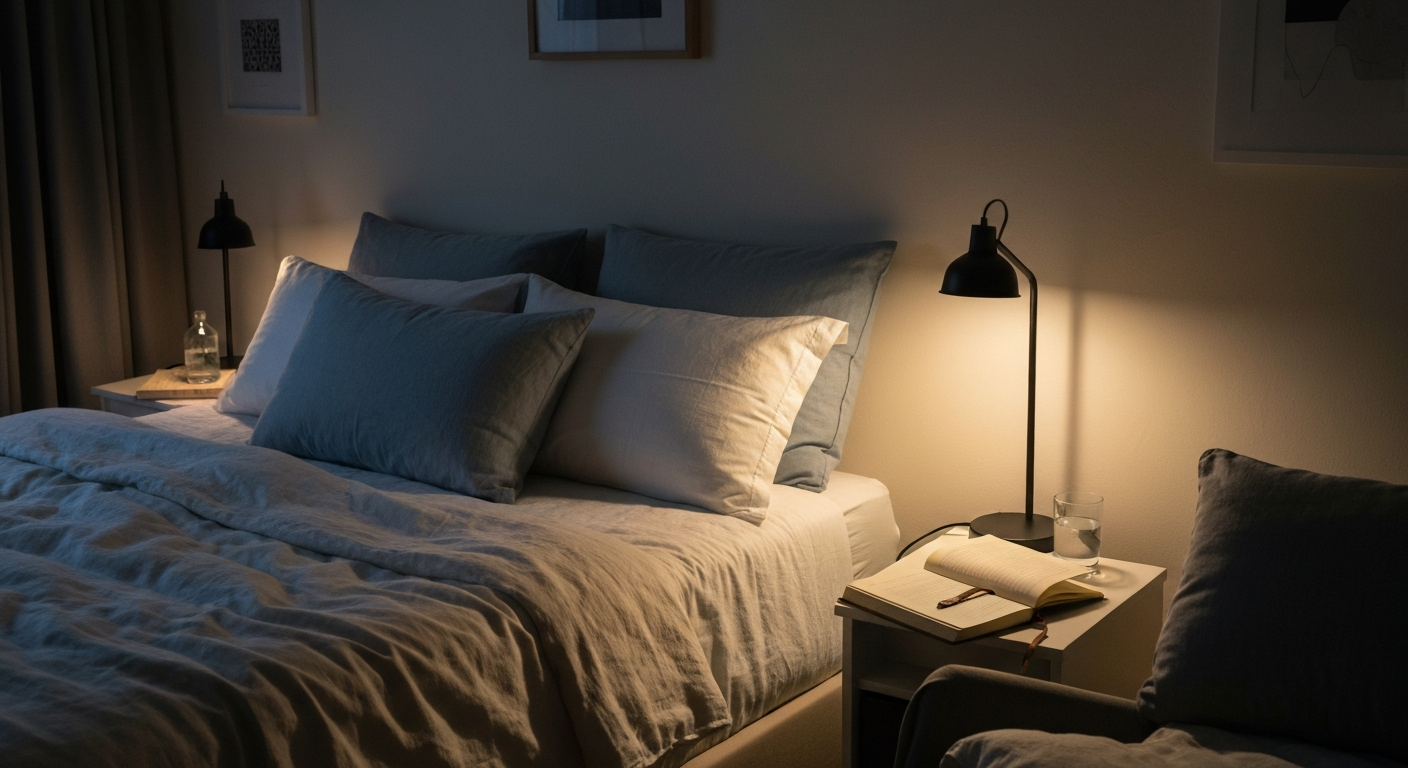
At 8:00 PM, the environment in my house completely changes. The big overhead lights go off. I switch to warm, low-level lamps. Our eyes have receptors that are incredibly sensitive to blue and bright light, which signals to the brain that it's still daytime. By dimming the lights, we invite melatonin to enter the chat.
This is also when I change out of my "day clothes" and into my softest, most breathable loungewear. This tactile shift is another powerful cue to your nervous system.
The Brain Dump
This is perhaps the most crucial 5 minutes of my entire day. I sit down with a physical notebook and a pen, and I write down everything swirling in my head. The to-do list for tomorrow, the email I forgot to send, the random worry about my teenager, the grocery items we need.
Once it's on paper, my brain stops trying to hold onto it. It's as if I've told my subconscious, "I have captured this information. You don't need to keep reminding me of it while I'm trying to sleep." Do not do this on your phone—the blue light and the temptation to check other apps will defeat the purpose.
The "No Screens in Bed" Rule
I used to scroll until my eyes closed. Now, the phone stays plugged in across the room, or better yet, in the kitchen. If I need a distraction, I read a physical book or listen to a sleep meditation. The blue light from screens suppresses melatonin just when you need it most, and the content (news, social media) spikes cortisol. Your bed is for sleep and intimacy. That's it.
Phase 3: The Physical Wind-Down (9:00 PM - 10:00 PM)
The Magnesium Moment
Around 9:00 PM, I prepare my sleep support. Magnesium glycinate has been an absolute game-changer for my sleep quality and muscle relaxation. Unlike other forms of magnesium, glycinate is highly absorbable and gentle on the stomach. I take it with a small cup of chamomile or tart cherry juice (which naturally contains melatonin). This warm drink has become a comforting ritual that I look forward to all day.
Skincare as Self-Care
Washing my face used to be a chore I rushed through. Now, I treat it as a mindful transition. I take my time massaging the cleanser into my skin, feeling the warm water, and applying my moisturizers. It's a few minutes of pure focus on my physical body, bringing me out of my head and into the present moment.
Gentle Movement and Temperature Drops
If I'm feeling particularly tense, I'll do 5 minutes of gentle stretching—child's pose, cat-cow, a seated forward fold. Nothing strenuous, just releasing the physical tension accumulated throughout the day.
Finally, I make sure the bedroom is cool. Our core body temperature needs to drop slightly for us to fall and stay asleep. Keeping the room between 60-65°F (15-18°C) has been crucial, especially when dealing with the unpredictable thermostat of perimenopause.
What Happens When You Still Wake Up?
Let's be realistic. Even with the perfect wind-down routine, midlife hormones are unpredictable. You might still wake up at 3 AM. When this happens, the most important thing is your reaction to it.
Do not look at the clock. Knowing the time only fuels the anxiety of "I only have three hours left to sleep." If you can't fall back asleep within 20 minutes, get out of bed. Go to a dimly lit room, read a boring book, or do some deep breathing until you feel sleepy again. Lying in bed feeling frustrated only trains your brain to associate your bed with stress.
Consistency is Your Anchor
You don't have to do it perfectly every night. Life happens. But the goal is to build a predictable rhythm that tells your body, "You are safe, the day is done, it's time to rest." Start with just one small change tonight—maybe it's the 8:00 PM sensory shift, or writing down your thoughts. Over time, these small habits stack into a powerful signal that will help you reclaim your nights.
Want my complete evening routine checklist?
Download the free 'Midlife Sleep Toolkit' for the exact steps, product recommendations, and templates I use to guarantee a good night's rest.
No spam, ever. Just honest midlife support delivered to your inbox.
Looking for tools that actually help?
I've curated a collection of products and resources specifically for this stage of your midlife journey.
Explore the Midlife ShopShare this article